Dying to Be Pink
The Strange Story of Salmon and Our Obsession with Aesthetic Food
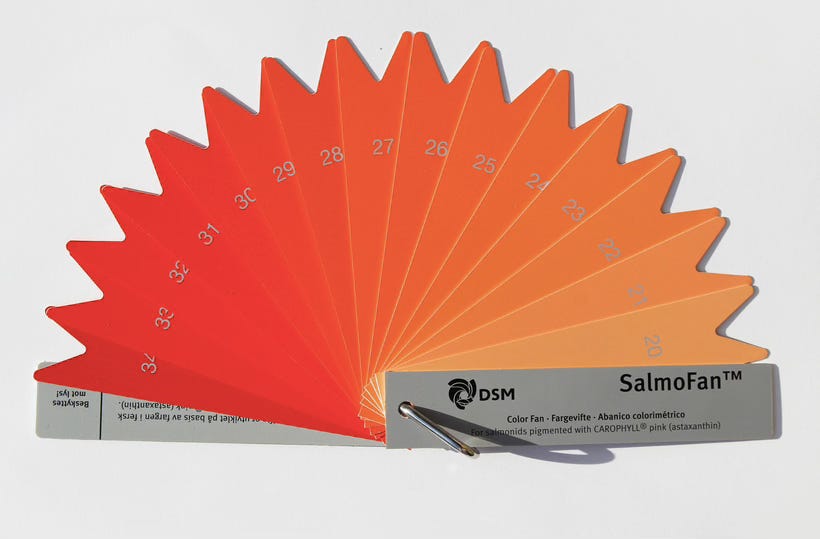
Photo: Salmofan, Journal of Agricultural and Environmental Ethics
Picture this: a plump fillet of salmon, glistening with a deep coral hue, ready to be seared to perfection. It looks fresh, natural, and exactly the way salmon should be—or so we’ve been led to believe. But what if I told you that the color of your salmon has less to do with nature and more to do with a pigment chart?
Wild salmon owe their vibrant pink color to a diet rich in krill and other crustaceans. Farmed salmon, on the other hand, lack access to this diet and naturally appear an unappetizing shade of gray. Enter the SalmoFan (pictured above), a color swatch tool used by fish farmers to select the exact shade of pink they want their salmon to be. Through synthetic or naturally derived astaxanthin—a carotenoid pigment—these farmed fish are dyed from the inside out to match consumer expectations. In other words, your salmon is color-coded for your approval.
This isn’t just a fishy phenomenon. From wax-coated apples to unnaturally bright egg yolks and even seedless watermelons bred for uniformity, our food system has been engineered to meet an aesthetic ideal rather than reflect the natural diversity of what we eat. In an age where Instagrammable meals reign supreme, we've grown accustomed to food that looks right, even if that means it has been modified, dyed, or engineered to meet those expectations. The result is a global food industry that prioritizes visual appeal over nutrition, taste, and environmental sustainability.
Consider the perfectly red tomato sitting on a grocery store shelf—bred not for flavor but for its ability to withstand long-distance shipping and maintain a uniform appearance. Or the countless fruits and vegetables that never make it to market because they’re deemed too “ugly” for consumers. The same applies to meat and dairy: the golden yolks of pasture-raised eggs come from a diet naturally rich in varied nutrients, while factory-farmed eggs are often enhanced with feed additives to achieve the same look. In every aisle of the supermarket, we’re making choices that reinforce a system where appearance trumps authenticity.
But at what cost? The push for visual perfection often comes at the expense of biodiversity, flavor, and nutrition. Heirloom varieties of fruits and vegetables have been sidelined for standardized supermarket produce, and food waste skyrockets as "ugly" but perfectly edible items are discarded. In the case of salmon, the desire for that perfect pink fillet has reinforced an industry reliant on feed additives, intensive farming practices, and a marketing illusion that keeps consumers in the dark about what their food truly looks like.
The consequences stretch beyond individual preference. The food industry's obsession with aesthetics leads to enormous environmental impacts, from the depletion of natural fish populations to the excessive use of pesticides, fertilizers, and genetic modifications in produce farming. Food waste alone contributes significantly to greenhouse gas emissions, as discarded produce rots in landfills rather than nourishing communities.
So, what if we let food be food? What if we embraced the natural color, shape, and irregularities of what we eat rather than insisting it conforms to an arbitrary standard? Instead of asking, "Why is this salmon gray?" we should start asking, "Why do we expect it to be pink in the first place?"